Chicago’s humid continental climate brings subzero winter stretches that freeze supply lines in the city’s older brick and frame homes. In neighborhoods such as Lincoln Park and Hyde Park, many structures pre-date 1940 and still rely on galvanized or cast-iron piping that cracks when temperatures drop. Once a line bursts, water travels quickly through plaster-and-lath walls and into joist bays, so extraction crews must reach the property within hours to keep the moisture load from saturating structural members.
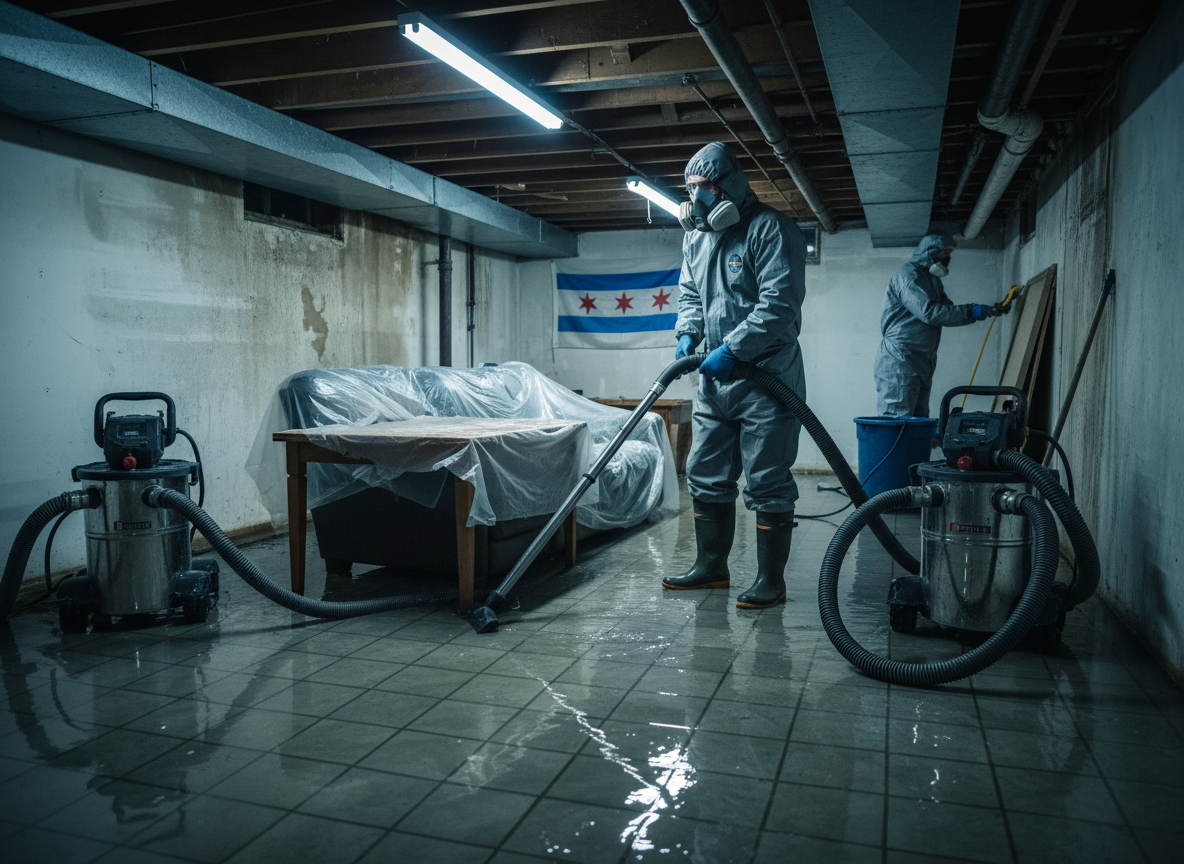
Cook County basements sit close to the water table, especially near the Chicago River and Lake Michigan shoreline. Spring thaws and heavy summer storms push groundwater through porous limestone foundations common in Wicker Park and Logan Square. Extraction teams use truck-mounted pumps and submersible units sized for the volume, then follow with moisture meters to locate hidden pockets behind brick veneer or under tongue-and-groove flooring before mold colonies establish.
Nearby suburbs such as Evanston and Oak Park share the same housing stock and weather patterns, so crews routinely cross the city line for extraction calls. In these older homes, narrow stairwells and finished lower levels limit equipment access, forcing technicians to stage portable extractors on the first floor and run hoses down interior staircases. The added handling time directly affects how much standing water can be removed before it migrates into adjacent units in multi-family buildings.
Technician insight
In Chicago, the thing that catches most people out with Emergency Water Extraction is how fast water travels through the plaster-and-lath walls and under the wide oak floors of pre-1940 homes in Lincoln Park and Hyde Park; a small pipe burst on the second floor can saturate joists two stories down before the homeowner notices.
Wicker Park Pipe Burst
A second-floor supply line froze and split during a January cold snap in a Wicker Park two-flat. Water migrated behind plaster walls and into the first-floor ceiling. Crews extracted standing water with portable units, mapped moisture through the lath, and ran drying equipment for four days to protect the original hardwood.
Emergency Water Extraction Services We Offer
✓Burst Pipe Extraction
Immediate removal of water from supply-line failures in kitchens and baths common to pre-war Chicago homes.
✓Flooded Basement Extraction
Pumping of groundwater or storm-water intrusion typical after heavy rains in low-lying blocks of the South Loop and Bridgeport.
✓Sewage Backup Extraction
Safe removal and containment of contaminated water from main-line backups that affect older clay-tile sewers in Wicker Park and Uptown.
✓Appliance Leak Extraction
Extraction around failed water heaters, washing machines and refrigerators in multi-unit buildings throughout Lakeview and Rogers Park.
✓Crawl Space Water Removal
Clearing standing water from low-access crawl spaces found under many bungalows in Logan Square and Andersonville.
Emergency Water Extraction Cost in Chicago, IL
| Service | Typical Range | What Affects It |
|---|---|---|
| Single-room extraction | $200–$450 | Limited to one level under 300 sq ft with easy access |
| Basement extraction | $600–$1,400 | Includes multiple rooms and stairwell access |
| Crawl space extraction | $350–$750 | Tight access and limited headroom increase labor |
| Multi-unit or commercial space | $900–$2,200 | Larger volume and coordination with building management |
Ranges are typical for Chicago, IL and confirmed with an exact written quote before any work starts.
How it works
- 1
Site Assessment
Technicians inspect the source, measure water depth, and identify affected materials in the specific Chicago construction type.
- 2
Water Removal
Truck-mounted and portable pumps extract standing water while protecting hardwood floors and finished surfaces typical in local homes.
- 3
Hidden Moisture Detection
Infrared cameras and pin meters locate residual moisture behind plaster walls and under flooring in older Cook County properties.
- 4
Equipment Setup And Monitoring
Air movers and dehumidifiers are placed, with daily visits to adjust settings until moisture readings return to normal.
Pricing
Cost depends on water volume, number of affected rooms, and access constraints in older Chicago buildings; on-site assessment is provided before work begins.