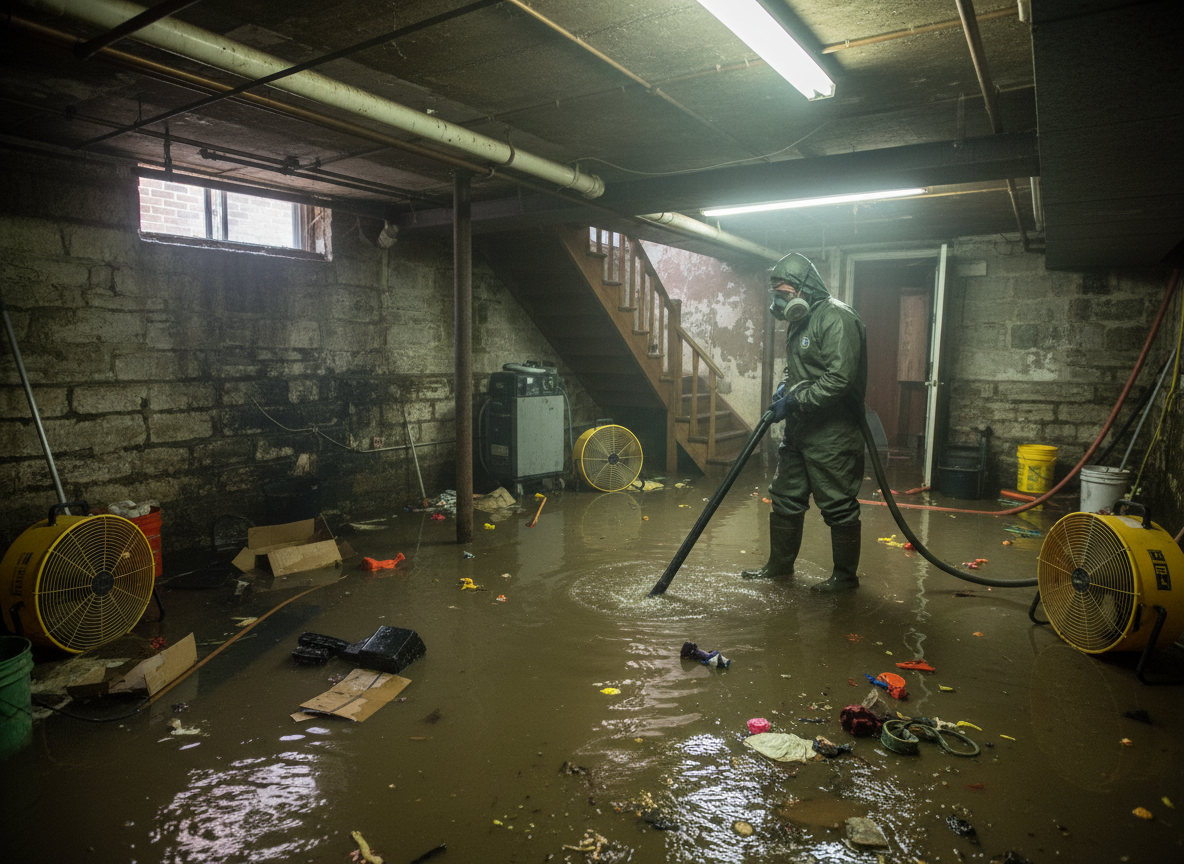
Chicago's humid continental climate brings heavy spring rains and winter freezes that stress older masonry foundations common in neighborhoods like Bridgeport, Pilsen, and Rogers Park. Basements in these pre-1940 buildings often feature stone or early concrete walls that allow groundwater to push through cracks when the soil stays saturated. Crews must first map hidden voids behind plaster or paneling before extraction to avoid leaving pockets that later feed mold.
Sump pump failures spike after summer thunderstorms when power flickers across the West Loop and South Loop. In these cases, water can rise above finished flooring within hours, saturating joist bays and insulation. Extraction equipment must be sized for the tight stairwells typical of Chicago two-flats, and dehumidifiers need to run longer because lake-effect humidity keeps indoor moisture high even after visible water is gone.
Evanston and Oak Park border properties share the same glacial clay soils that trap water against foundations during rapid thaws. Technicians frequently encounter combined sewer backups in these areas, requiring separate handling of contaminated water versus clean supply-line leaks. Proper disposal routes and air movers placed to pull moisture from under built-in cabinetry prevent repeat calls that owners in newer suburbs rarely face.
Technician insight
In Chicago, the thing that catches most people out with Flooded Basement Cleanup is how the clay soils around Hyde Park and the South Loop hold water against 100-year-old limestone foundations long after the rain stops, so extraction alone never finishes the job without extended drying cycles.
Wicker Park Two-Flat After Frozen Pipe
A cold snap ruptured a supply line in a 1920s two-flat, sending water across the dirt-floor utility room and into the finished rec space above. Extraction revealed moisture trapped behind the original plaster and in the floor joists. Targeted drying and antimicrobial application restored the space without full wall removal.
Flooded Basement Cleanup Services We Offer
✓Sump Pump Failure Water Removal
Rapid pumping and extraction after sump pump outages common during Chicago storms, followed by targeted drying of lower walls to protect joists in older homes.
✓Burst Pipe Basement Extraction
Isolation and removal of water from frozen or corroded supply lines that fail in unheated Chicago basements during winter cold snaps.
✓Storm Flooded Basement Cleanup
Handling of rainwater intrusion through window wells and foundation cracks in neighborhoods like Logan Square and Andersonville after heavy downpours.
✓Sewer Backup Basement Restoration
Contaminated water extraction and disinfection after combined sewer events that affect low-lying blocks near the Chicago River and in Uptown.
✓Finished Basement Drying
Moisture removal from carpet, drywall, and built-ins without demolition where possible, using low-profile equipment suited to Lincoln Park and Lakeview row houses.
Flooded Basement Cleanup Cost in Chicago, IL
| Service | Typical Range | What Affects It |
|---|---|---|
| Initial Assessment And Extraction | $350–$750 | Higher in multi-level basements or when access requires equipment disassembly for narrow Chicago stairwells. |
| Daily Equipment Rental | $150–$300 | Varies with number of air movers needed for open joist spaces versus finished rooms. |
| Contaminated Water Handling | $400–$900 | Increases with sewer backup volume and disposal requirements in older combined-sewer neighborhoods. |
Ranges are typical for Chicago, IL and confirmed with an exact written quote before any work starts.
How it works
- 1
On-Site Assessment
Technicians inspect foundation walls, floor drains, and adjacent soil conditions to identify the water source and any hidden migration paths in Chicago's typical masonry construction.
- 2
Water Extraction
High-volume pumps and wands remove standing water while protecting electrical systems common in pre-war homes throughout Cook County.
- 3
Structural Drying
Air movers and dehumidifiers are positioned to pull moisture from joist bays and masonry, with daily moisture readings to confirm progress.
- 4
Sanitizing And Final Check
Affected surfaces receive antimicrobial treatment, followed by a walkthrough to verify dryness before any reconstruction begins.
Pricing
Costs depend on water volume, depth of saturation into older flooring systems, and whether the home sits on clay-heavy lots near the lake.